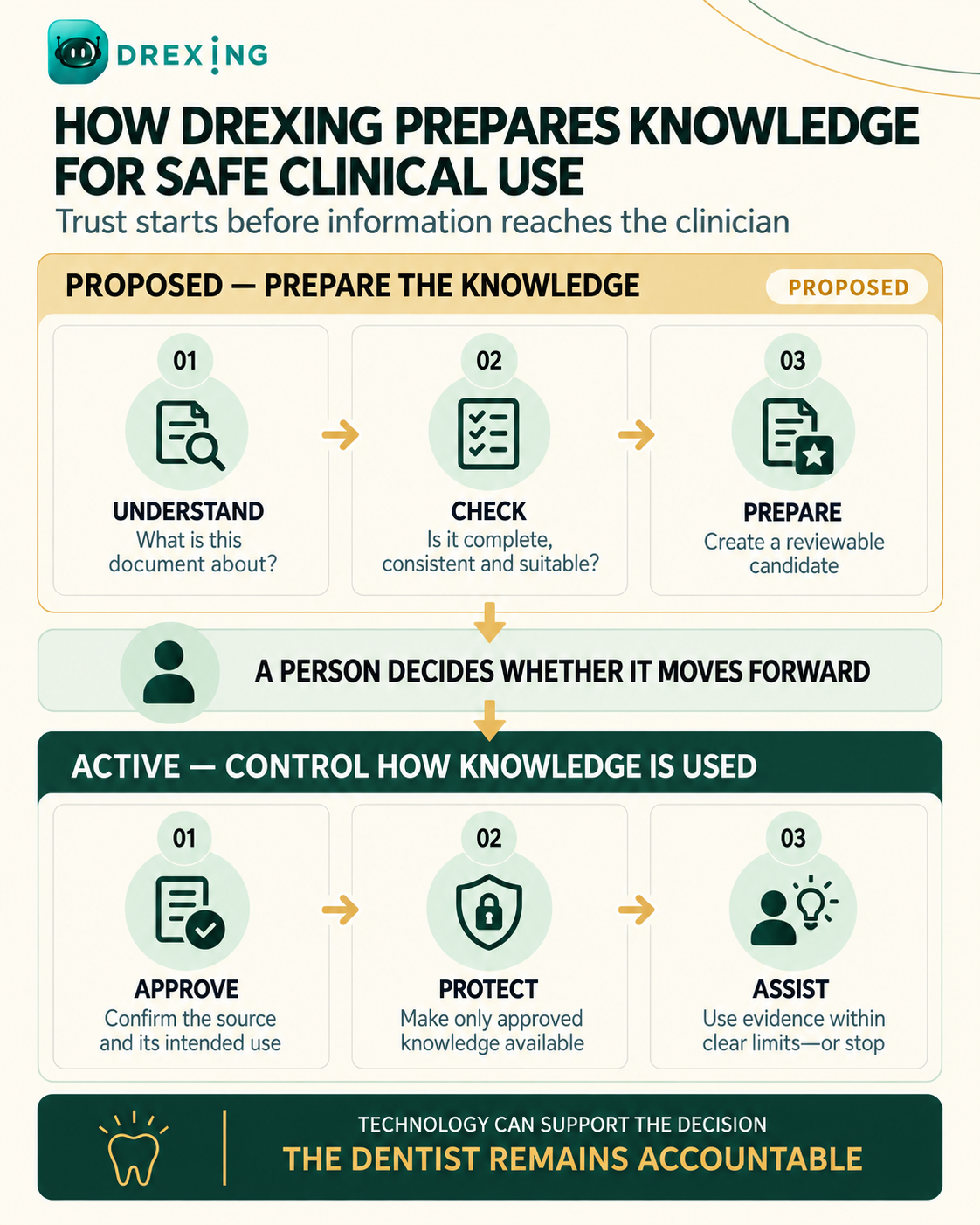
Artificial intelligence can only be as dependable as the knowledge it is permitted to use. Provenance, authority, currency, approval and clinical context also matter.
Many retrieval systems collect documents, divide them into passages, index them and expose them to a language model. That is not enough for clinical use, where outdated or unauthorised material could influence professional judgement.
Drexing therefore treats clinical knowledge as a governed release artefact, not simply content available for retrieval. A proposed Drexiant capability would strengthen this approach by starting governance before admission.
Before admission: staged intelligence
Knowledge Intake Intelligence is a proposed Drexiant capability in discovery, not an active service. It would help a submitter understand a source, identify one or more applicable knowledge schemas, recommend typed metadata and validate the proposed package deterministically.
Its output would be a reviewable knowledge candidate: a staged recommendation retaining any difference between declared and inferred information.
Confidence would route work; it would never grant authority. A mismatch would require review, and the capability would have no write-capable connection to Drexing admission. Only a human or governed-process decision could submit the candidate.
From admission to governed evidence
After submission, the active Drexing lifecycle applies separate controls:
- Admission: Contain, classify and check the source.
- Human review: Verify its origin, authority and intended use.
- Deterministic extraction: Create reproducible, traceable fragments.
- Validation and promotion: Require structural validation and separate human approvals before creating a signed, immutable release.
- Governed retrieval: Return approved knowledge.
- Bounded reasoning: Reason only within an authorised evidence envelope—and hold when evidence is inadequate.
The proposed pre-admission capability remains distinct from them.
Three governance questions
Knowledge governance asks whether a source is trustworthy enough to enter the authorised collection. Retrieval governance asks whether a person, purpose and context may access it. Reasoning governance asks what the system may infer, recommend or initiate afterward.
Passing one test does not imply passing the others. Permission to retrieve evidence never grants permission to make a clinical decision. The dentist retains authority to accept, amend, reject and save every material clinical outcome.
Evidence before claims
Admission, extraction, promotion and governed retrieval have been accepted. Governed retrieval has been exercised with a release and cited fragments. Bounded reasoning has been deployed but remains disabled until pilot use, monitoring, fallback behaviour and assurance evidence are approved.
The proposed intake capability is earlier in its journey: its architecture is drafted, classifier choice remains open and implementation has not begun. That distinction matters. Trustworthy governance requires accurate status as well as controls.
Trust should begin before admission and continue through every decision about what knowledge the model may see and how it may be used.