When designing an artificial-intelligence product, it is tempting to begin with technology: choose a model, connect some data and start building features.
At Drexing, we start somewhere else—with the outcome that a dental practice needs.
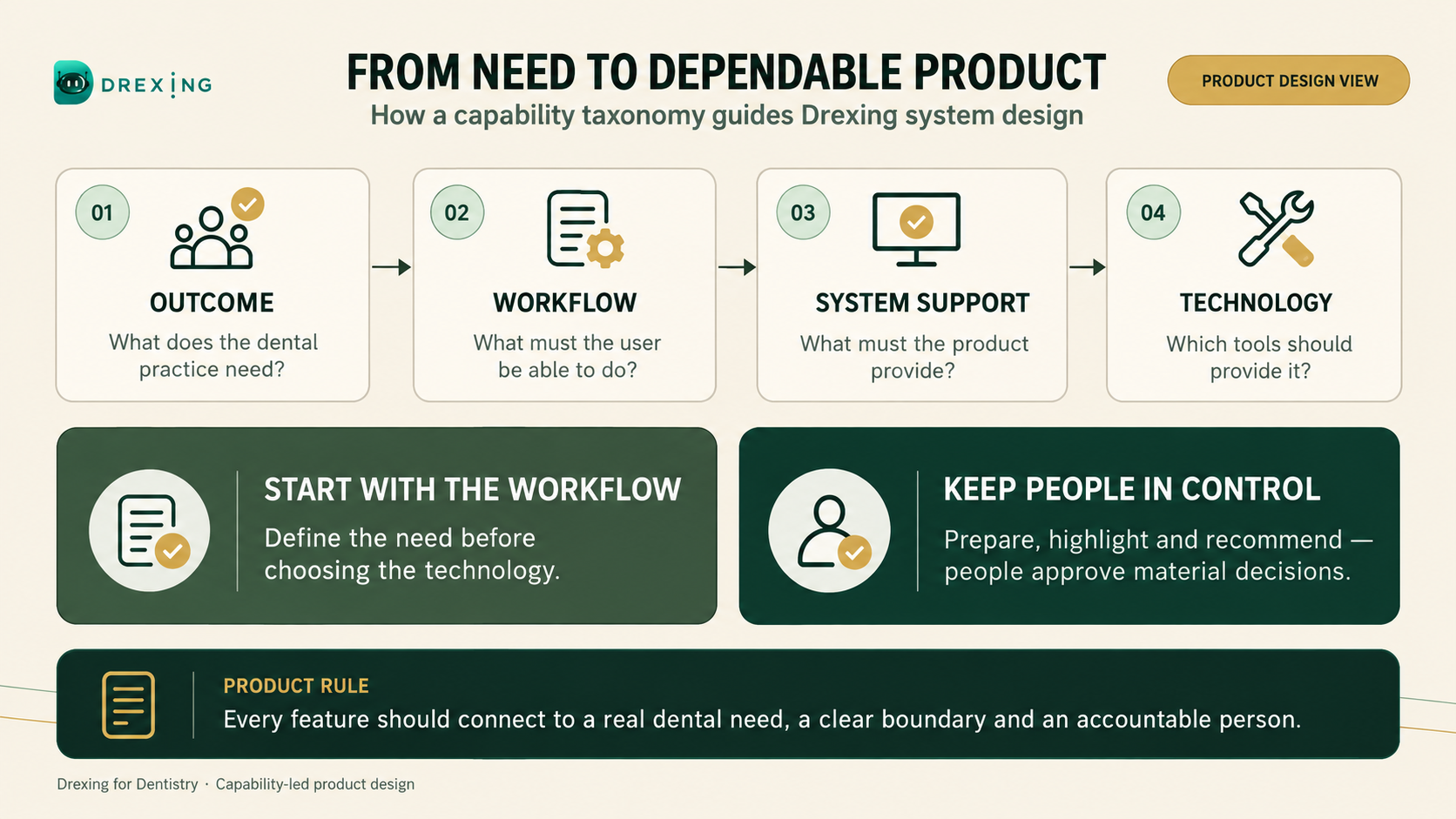
A capability taxonomy is simply a structured way of describing what the product must be able to do. It helps product managers connect a business problem to a workflow before choosing the technology.
Four questions guide the design
Begin with the result the dental practice and its patients need.
Describe the workflow in language the dental team recognises.
Identify the product behaviour required at each point in the workflow.
Select tools only after the need and boundaries are clear.
Start with the dental workflow
Consider clinical documentation. The real requirement is not “generate a note with artificial intelligence.” A dental practice needs a complete, accurate and reviewable clinical record, while the dentist remains responsible for approving it.
That outcome can be broken into smaller capabilities:
- Capture the relevant consultation information.
- Organise it into a clinical structure.
- Identify missing or unclear details.
- Prepare a draft for review.
- Allow the clinician to amend it.
- Require approval before it becomes part of the record.
This gives the product team a clearer backlog. It also prevents the capabilities of a particular model from defining the product. Technology changes quickly; the underlying needs of the dental workflow are more stable.
Separate assistance from authority
The taxonomy helps us define where artificial intelligence can assist and where a person must remain in control. Drexing may prepare information, highlight uncertainty, recommend a next step or route something for review. That does not mean the system should independently approve a clinical record or make a treatment decision.
For each proposed capability, the product team can ask what information it needs, who may use it, what happens when information is missing, where human review is required and how the workflow should fail safely.
These questions expose gaps before development begins. A feature may produce an impressive result but still be unsuitable for release because it lacks traceability, human approval or a safe fallback.
A design tool, not a feature claim
A capability taxonomy is not a list of features already built. It is a product-design tool that helps us distinguish what users need, what the system must support and what still requires evidence.
For Drexing, every feature should connect to a real dental workflow, operate within clear boundaries and keep an accountable person in control. That is how we move from an interesting artificial-intelligence demonstration to a product that dental teams can use with confidence.